Preliminary
Exercise
Evaluation
1. What
was your brief?
Film a short conversation between two people
that demonstrates 180-degree sign, shot-reverse-shot and match on action.
2.
Briefly describe 180-degree line,
shot-reverse-shot and match on action.
Match on Action
Match on action is a
simple video editing technique. It is when the perspective of the camera
changes during a scene but is cut so that the scene continues to flow.
Shot-Reverse-Shot
A shot-reverse-shot is
a film used when characters are having a conversation. One
character is shown looking at a second character then the second character is
shown looking at the first character. As the characters are shown in opposite
directions, the audience assumes that they are looking at each other.
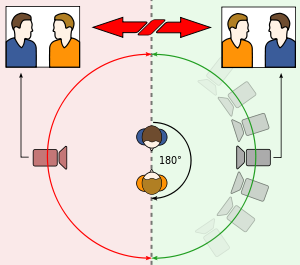
180-Degree Line
The 180-degree rule is
a vital part of video production. It refers to an imaginary line that cuts
horizontally through the middle of the scene, with respect to the camera.
An actor crossing the line changes the audience’s perspective, which causes
confusion and disorientation.
3. What
planning did you do?
During planning for our preliminary exercise
we planned a script and storyboards, conducted research of our filming
location, wrote a shot list and conducted a risk assessment.
Script
Firstly, we had to consider writing a script
for our short film. This was completed on a programme called “Celtx”. This
allowed us to plan some stage directions and speech for the actors. Everyone
eventually had a copy of one of the scripts written by a member of the group
(Cameron).
Storyboard
Next, we all drew a storyboard for our own
individual scripts. Within each drawing of the storyboard, we demonstrated the
different types of shots that are to be used in the preliminary exercise in
relation to the conversation. At the side of the drawings were the stage
directions and speech that related to that particular part of the shot in
question.
Location Research
Then, we had to book a room for the filming.
We had to ensure that the lighting and volume levels we suitable enough for
filming.
Shot list
Prior to filming, we had to create a
chronological list of the different shots that were to be used in the film. This
had to include a long shot, a couple of shot-reverse-shots, a two-shot, a
close-up and a medium-long shot.
Risk Assessment
To ensure we were safe during the filming and
met health and safety regulations, we conducted a risk assessment.
4. Describe
how you filmed the piece and any difficulties you had.
During filming we had two actors and to
people performing the camerawork and directing. The two cameramen worked
together to ensure that the shots followed the shot list, storyboards and
script so that nothing was missed out during filming. We encountered some
difficulty as the room had a peculiar layout as the space was quite small.
Subsequently, it was more difficult to film a two-shot. Also, the lighting was
a little dark but was acceptable for filming.
5. How
did you edit the film?
We used Final Cut Express to edit our final
piece. This helped us to cut and apply transitions to the film easily. Furthermore, it ensured that continuity was right throughout the film. All of
the group contributed to the editing process. We also applied sound bridges to
the speech on Final Cut Express.
6. How
does your film demonstrate 180-degree line, shot-reverse-shot and match on action?
Shot-reverse-shots were used several times
during the film that included dialogue between Natalie and myself. When each
person talked, the camera switched position to look at that actor in
particular.
A match on action was used when I walked down
the corridor, through a door and sat down. This was shown by cutting together a
long shot, a close up of the door handle and a medium long shot from inside the
room.
Throughout the film process, camera did not
cross the 180- degree line as it was always within 180-degrees of the actors.


.jpg)


