Friday, 29 November 2013

Early Research

Match on Action

A match on action is a very simple but essential technique, where the perspective of the camera changes during a scene and then continues to flow. It is an example of continuity editing and helps the audience understand what is happening

180-degree Rule

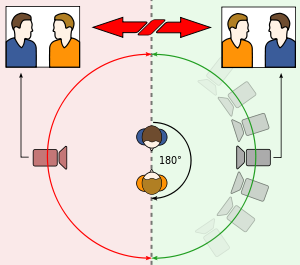
This is a vital part of the production, it refers to an imaginary line which cuts through the middle of a scene. If you have crossed the line, it changes the viewers perspective causing confusion. You should avoid crossing the line.


Shot-reverse-shot

It is a film technique where one character is shown looking at another character and then the other character is shown looking back at the first character. The audience assume the character are looking at each other since they are shown facing the opposite direction.


Preliminary Exercise Evaluation

Preliminary Exercise Evaluation


1. What was your brief?
We had to film a short conversation between 2 people. We had to include shot-reverse-shot and match on action shots without crossing the 180-degree sign.

2. Briefly describe 180-degree line, shot-reverse-shot and match on action.

180-degree line
This is a vital part of the production. It refers to an imaginary line which cuts through the middle of a scene. If you have crossed the line, it changes the viewers perspective causing confusion. Avoid crossing the line.
Shot-reverse-shot
It is a film technique where one character is shown looking at another character and then the other character is shown looking back at the first character. The audience assume the characters are looking at each other since they are shown facing the opposite direction.
Match on action
Match on action is a very simple but essential technique, where the perspective of the camera changes during a scene and then continues to flow.

3. What planning did you do?
The group each made a script and storyboards, we conducted research of our filming location, we created a risk assessment and wrote a shot list. 
Script
Firstly, we had to create a script for our short film, we did this by using a programme called "Celtx." This allowed us to put what we were thinking and the ideas we wanted to do, in words therefore we could create a script for our short film. In the end, we all had a copy of one of the groups script (Cameron).
Storyboards
Next we drew storyboards for each of our scripts. This included different types of shots and when we would use them in the preliminary exercise. At the side, there was the stage directions and speech that related to that part of the shot in question. 
Location Research
Then, we had to book a room for filming. We had to ensure that the lighting was sufficient and the volume was suitable for filming 
Shot List
Before filming, we had to make a chronological list of the types of shots we were using. We had to include long shots, shot-reverse-shots, a two shot, a close up a medium-long shot.
Risk Assessment 
We conducted a risk assessment as we had to ensure we were safe during the filming and we met all health and safety regulations. 

4. Describe how you filmed the piece and any difficulties you had
We had 2 actors altogether, myself and Jodie and we had a director and a cameraman. The director and cameraman worked together to ensure we used all the essential shots that was required and everything was running smoothly. One difficulty that occurred was the spacing, as we were in a very small space and it was difficult to get some shots (two-shots) also the lighting differed at some points but it didn't ruin it.

5. How did you edit your film?
To edit our film, we used Final Cut Express, this allowed us to edit our film accurately and to a good standard. It ensured continuity throughout the film. Everyone in the group had an input. 

6. How does your film demonstrate 180-degree line, shot-reverse-shot and match on action?
Shot-reverse-shots were used throughout the film and multiple times, during the conversation mostly. We used match on action shot when our actor walked into the film, into the room and then sat down. Throughout the film, we did not cross the 180-degree line. 


Saturday, 16 November 2013

Character Profiles

Name: Leo
Age: 18
Occupation: Student at Barnsley College
Character attributes: Short, dark brown hair with brown eyes. Dresses relatively casually. Witty but has a tendency to embarrass himself. Looks after Jess "like a brother". A fairly optimistic character.
Role in the film: Best friend of Jess. Arriving in college after the weekend, he realises about his drunken antics on Saturday night in a conversation with Jess. It seems to embarrass him.

Name: Jess
Age: 18
Occupation: Student at Barnsley College
Character attributes: Long, dark brown hair with a choppy fringe and brown eyes. Often wears red lipstick. Has a humorous personality and enjoys poking fun at Leo. Holds a positive attitude in life.
Role in the film: Best friend of Leo. In college, she informs him about what he did on Saturday night when drunk. 

Story Board


Story Board


Friday, 8 November 2013

Evaluation photos


Preliminary Exercise Evaluation

Preliminary Exercise
Evaluation

1. What was your brief?

Film a short conversation between two people that demonstrates 180-degree sign, shot-reverse-shot and match on action.

2. Briefly describe 180-degree line, shot-reverse-shot and match on action.


Match on Action

Match on action is a simple video editing technique. It is when the perspective of the camera changes during a scene but is cut so that the scene continues to flow.

Shot-Reverse-Shot
A shot-reverse-shot is a film used when characters are having a conversation. One character is shown looking at a second character then the second character is shown looking at the first character. As the characters are shown in opposite directions, the audience assumes that they are looking at each other. 

180-Degree Line
The 180-degree rule is a vital part of video production. It refers to an imaginary line that cuts horizontally through the middle of the scene, with respect to the camera. An actor crossing the line changes the audience’s perspective, which causes confusion and disorientation.

3. What planning did you do?

During planning for our preliminary exercise we planned a script and storyboards, conducted research of our filming location, wrote a shot list and conducted a risk assessment.

Script
Firstly, we had to consider writing a script for our short film. This was completed on a programme called “Celtx”. This allowed us to plan some stage directions and speech for the actors. Everyone eventually had a copy of one of the scripts written by a member of the group (Cameron).

Storyboard
Next, we all drew a storyboard for our own individual scripts. Within each drawing of the storyboard, we demonstrated the different types of shots that are to be used in the preliminary exercise in relation to the conversation. At the side of the drawings were the stage directions and speech that related to that particular part of the shot in question.

Location Research
Then, we had to book a room for the filming. We had to ensure that the lighting and volume levels we suitable enough for filming.

Shot list
Prior to filming, we had to create a chronological list of the different shots that were to be used in the film. This had to include a long shot, a couple of shot-reverse-shots, a two-shot, a close-up and a medium-long shot.

Risk Assessment
To ensure we were safe during the filming and met health and safety regulations, we conducted a risk assessment.

4. Describe how you filmed the piece and any difficulties you had.

During filming we had two actors and to people performing the camerawork and directing. The two cameramen worked together to ensure that the shots followed the shot list, storyboards and script so that nothing was missed out during filming. We encountered some difficulty as the room had a peculiar layout as the space was quite small. Subsequently, it was more difficult to film a two-shot. Also, the lighting was a little dark but was acceptable for filming.

5. How did you edit the film?

We used Final Cut Express to edit our final piece. This helped us to cut and apply transitions to the film easily. Furthermore, it ensured that continuity was right throughout the film. All of the group contributed to the editing process. We also applied sound bridges to the speech on Final Cut Express.

6. How does your film demonstrate 180-degree line, shot-reverse-shot and match on action?

Shot-reverse-shots were used several times during the film that included dialogue between Natalie and myself. When each person talked, the camera switched position to look at that actor in particular.

A match on action was used when I walked down the corridor, through a door and sat down. This was shown by cutting together a long shot, a close up of the door handle and a medium long shot from inside the room.

Throughout the film process, camera did not cross the 180- degree line as it was always within 180-degrees of the actors.
Cameron Farrell Evaluation

Cameron Farrell

Preliminary Exercise Evaluation


Brief: to film a short conversation between two people that demonstrates
            180-degree line
            Shot reverse shot
            Match on action

180-degree line
The 180 degree line is the metaphorical line that should not be crossed when filming a conversation, this is done to make the placement of each person consistent and the audience isn’t confused.

Shot reverse shot
Shot reverse shot is when a shot is taken from over the shoulder of a character, this is used to show a first person point of view but whilst still showing the subject speaking, the shot is then switched over when the other person starts to speak.

Match on action
A match on action is when a shot is cut as a piece of action takes place, for example, when someone is walking towards a door the shot would cut just as their hand touches the handle, it would then cut to the inside of the room and keep continuity.

Planning
When planning our short film we had to consider a script, storyboards, locations, research, a shot list and a risk assessment.
To create a script we used a program called ‘Celtx’, this allowed us to create a short script for our work that everyone could have a copy of.
We drew out a storyboard for our work to ensure the whole cast was clear on how the filming would take place and come together as a whole.
We had to book out a room for our film location and ensured our lighting levels where suitable for filming.
Before we started filming we had to compose a shot list, this was to make sure no important shots where missed out from our production and we didn’t have to go back to film our work again.
To ensure we worked safely we had to create a risk assessment that insured everyone on set remained safe throughout filming.

Filming
When filming we had a cameraman, a director and two actors on set.The director decided the shot angles and worked with the cameraman to make sure the shots followed our shot list and nothing was missed out during filming. A Difficulty we had when filming was the small space we had to use the camera on the tripod.

Editing
To edit our film we used final cut express, this allowed us to edit our film to a good standard and do it easily, the film was edited with input from the whole group

How Our Film Met The Briefs Requirements
Our film made use of ‘shot reverse shot’ multiple times and we used it for the entirety of our short conversation, as well as this we used match on action for when our actor walked into our filming room.

During the whole filming process we ensured that we never crossed the 180-degree line.

Preliminary exercise evaluation

Brief: Film a short conversation between two people that demonstrates; 180 degree line, shot reverse shot, match on action.

180 degree line is when you film a conversation you stay on the same side of the people, so the background and people’s positions are consistent.
Shot reverse shot is showing the view of one person in a conversation from other the other’s shoulder. Then you swap, and show the other’s person from the other person’s shoulder.
Match on action is cutting shots so that movements seem fluid and continuous, even if they may have been filmed at different times/angles.

To plan, we firstly began by making a script on Celtx. This programme, although complex, gave the correct formations for the script, and gave it a professional look. Then, we created a storyboard. This allowed us to put our imagination onto paper of what we wished to create with our filming, and gave us a visual representation.  It also let us decide on which shot type to use. After this we chose a location that was suitable for our filming and matched the script/storyboard (long corridor, door and room) Next, we created a shot list which made sure everyone was aware of the shots needed, so we didn’t miss one when it came to filming. Finally we did a risk assessment do minimise potential hazards.

While filming, we had one person filming and an ‘over-seer’ to ensure they were no mistakes, and that there was good continuity. We overlapped action is shot, so that it was easier to edit. We made sure people were sitting in the same place, hands on doors at the same place, and walking at the same side of the corridor to ensure all shots matched up. We were careful to never cross over the 180-degree line, however once we were on the wrong side. However, because we checked each shot after filming we could see where this happened and was able to re-do it.

We used Final Cut Express to edit the film. It required carefully lining up the shots into the right order, and selecting the right second to make sure there was good match on action. We also had to cut the length of many, such as when the clip of our actor walking down the corridor was too long, or when someone was no on screen, but we were waiting for a door to close.


In our film, you can see our seated actors never swap sides and the background is consistent. This is because we carefully abiding by the 180-degree line rule. As well as this, we used shot reverse shot during the conversations between our two actors. We also carefully edited our film to ensure perfect match on action.

Friday, 20 September 2013

Early Research

Match on Action

Match on action is a simple video editing technique. It is when the perspective of the camera changes during a scene but is cut so that the scene continues to flow.

Shot-Reverse-Shot

A shot-reverse-shot is a film used when characters are having a conversation. One character is shown looking at a second character then the second character is shown looking at the first character. As the characters are shown in opposite directions, the audience assumes that they are looking at each other.

180 Degree Line of Action

The 180 degree rule is a vital part of video production. It refers to an imaginary line that cuts horizontally through the middle of the scene, with respect to the camera. Crossing the line change's the audiences perspective which causes confusion and disorientation. The only exception for crossing the line is "for effect".